
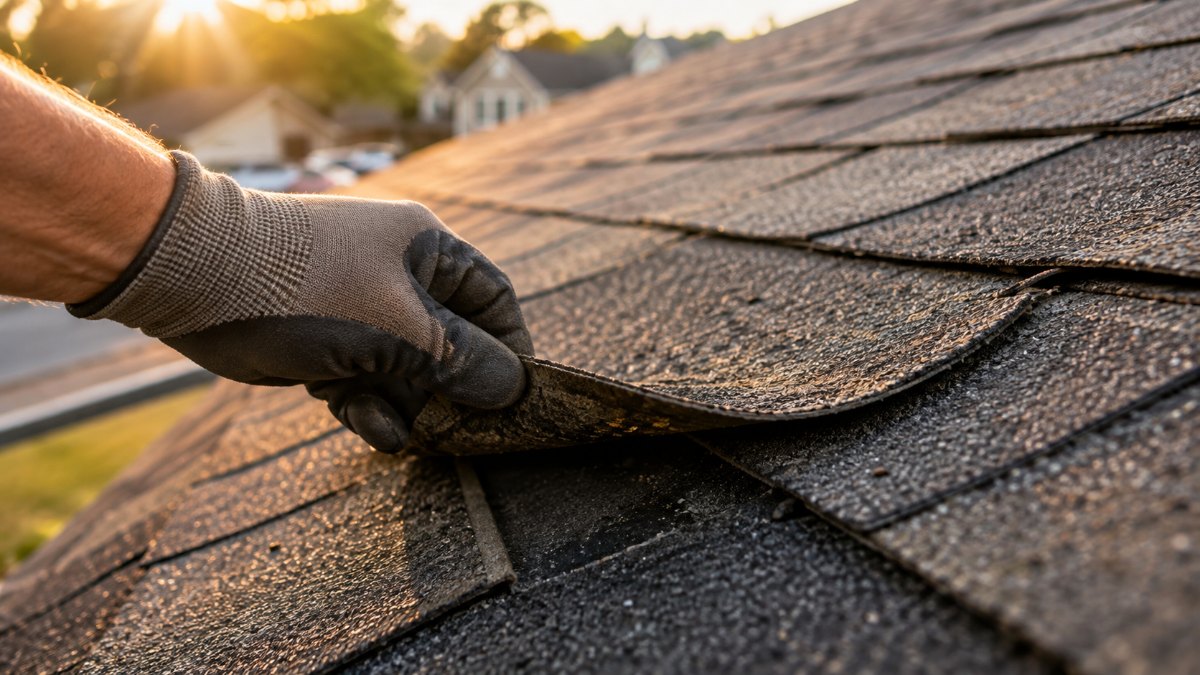
Question one: how old is it, really
Age is the first cut and most homeowners guess wrong by five years. Find the closing paperwork or the last permit if you can. A standard architectural shingle roof in the Mid-South is doing well to see twenty years of our sun and our storms; the premium lines go longer, three-tab goes shorter. If the roof is inside the first half of its life and the damage is local, repair is usually the right money. If it is in the back third, every repair dollar is a dollar you will spend again on the replacement anyway.
The tell we always looked for: granule loss in the gutters and downspout splash blocks. When the shingles are shedding their surface, they are done protecting the mat underneath, and no repair fixes that.
Question two: is the damage local or everywhere
A tree limb, a blown-off ridge cap, a flashing leak at the chimney, a handful of wind-lifted tabs on one slope: local. That is a repair, and a good one lasts. Hail bruising across every slope, cracked shingles on the south face from thermal cycling, or leaks in three different rooms: that is a roof telling you it is finished, and patching it is renting time you will pay for twice.
Our shop rule: if the repair estimate is creeping past a quarter of a replacement, or if it is the third repair on the same roof, we stop pretending and quote the replacement.
Question three: what is under the shingles
Decking and underlayment decide whether a repair is even honest. Soft spots when you walk it, dark stains on the attic side of the sheathing, or a roof that already has two layers on it mean the shingle is not the problem you are paying for. In those cases a repair is a coat of paint on a rotten board. Replace, and fix the deck while it is open.
If you cannot get in the attic yourself, ask whoever inspects it to photograph the underside. Any roofer who will not show you the attic photos is telling you something.
When repair is the smart money
Roof under twelve years old, damage on one slope or one detail, decking sound, no active leaks in multiple rooms, and you plan to be in the house long enough to get the value. Get the repair done right (matching shingle, new flashing, ice-and-water where it belongs) and move on with your life.
When replacement is the smart money
Roof past its mid-life with widespread wear, hail or wind damage on more than one slope, more than one layer, or a repair history that has become a subscription. In hail country there is a fourth case: a storm event with documented damage across the roof, where an insurance claim covers replacement and a repair would just be leaving money on the table. That is a conversation for your adjuster and your roofer together, not the roofer alone.
One thing we will say plainly because we ran a company: nobody should be pressured off a ladder into a replacement the same afternoon. If the answer is replace, it will still be replace tomorrow after you have slept on it.